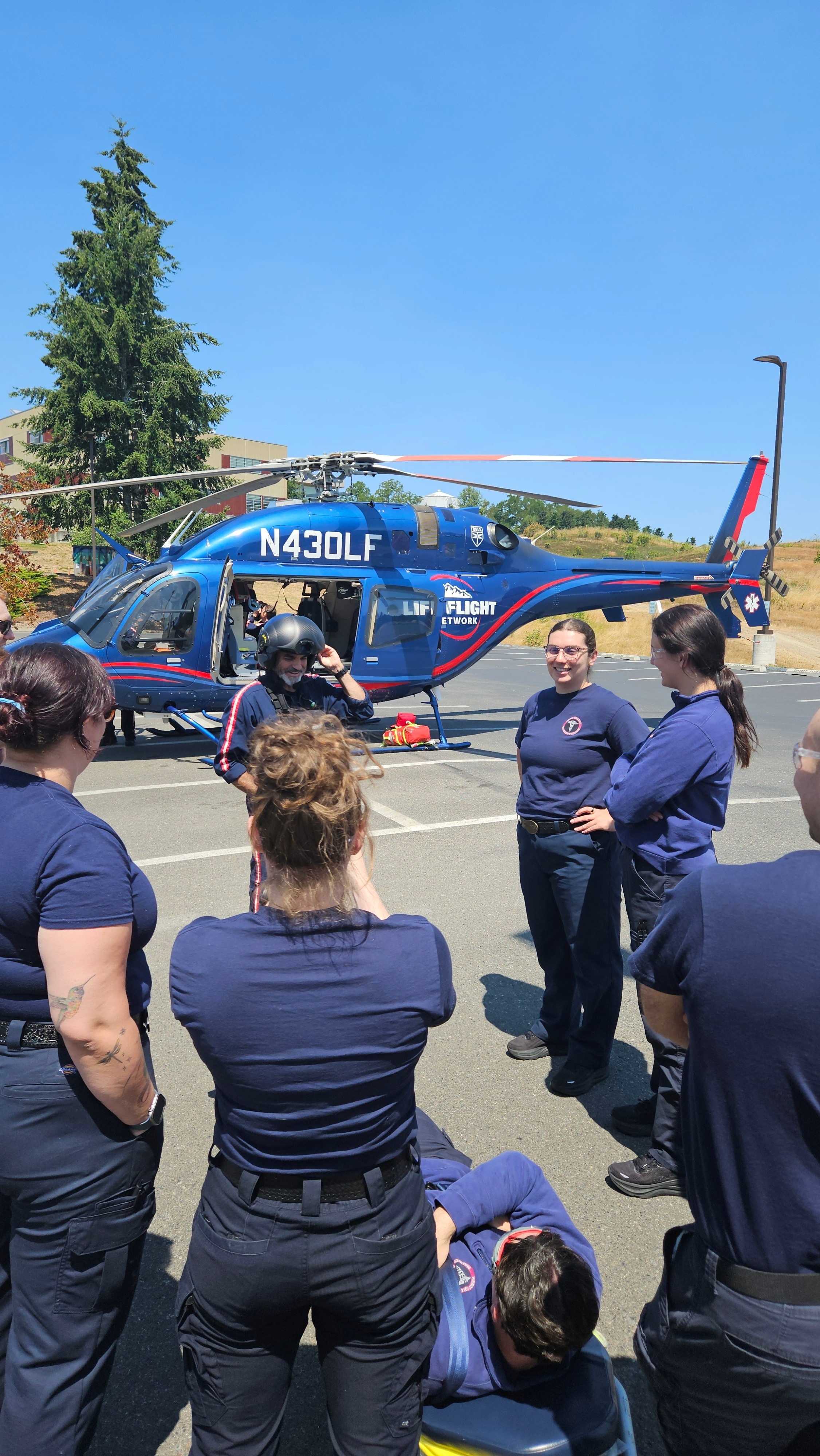
Pierce College Paramedic students had a unique opportunity to train with a crew from Life Flight Network this week when the nonprofit air and ground critical care transport service visited Pierce College Fort Steilacoom. The training gave students firsthand experience with the role air medical transport plays in emergency care while reinforcing the safety procedures and coordination required during helicopter operations.
Students from Pierce College's Paramedic Certificate program, as well as Emergency Medical Services (EMS) and Nursing programs were able to explore the aircraft, examine the specialized equipment, and learn directly from the Life Flight crew members what a typical rescue is like. About a dozen Paramedic Certificate program students also participated in a hands-on patient loading exercise. The students practiced loading a patient on a stretcher in and out of the helicopter while the rotors were running – also known as a "hot load."
Life Flight Network, the nation's largest nonprofit air medical rescue organization, provides critical care transport across the Pacific Northwest. During the training, students learned how and why Life Flight is activated, the importance of early activation in patient care, and how flight crews locate landing zones using street addresses, GPS coordinates, or regional descriptions.
A major focus of the training was on scene safety. Students learned the essential safety guidelines when working with an air rescue team, the responsibilities of designated on-site scene safety officers, the importance of clear communication with the aircraft, and how flight crews coordinate with first responders and hospital staff during patient transfers.
The visiting crew included a pilot, flight nurse, and a flight paramedic, Kurt Middleton, who also happens to be a part-time faculty member in Pierce College's Paramedic program. While this is Middleton's first year of teaching at Pierce College, he's been working with Life Flight for more than four years.
The college's 12 paramedic students were able to participate in a hands-on exercise with the Life Flight crew where they practiced both cold loading – loading a patient while the helicopter is not running – and hot loading procedures. The training came at a pivotal point in the students’ one-year program. The cohort recently completed their emergency department clinical rotations and are now beginning their clinical rides with EMS departments. Throughout the summer, each student will complete thirteen 24-hour field shifts, applying their classroom knowledge in real world emergency situations.
"It was really interesting to see all the equipment they carry," said paramedic student Sienna Greenberg. "We got to see their IV storage, and blood storage; they also carry liquid oxygen which is not something we typically use on the ground so that was really interesting to learn about."
Pierce College's one-year paramedic certificate program prepares current EMTs to provide advanced emergency medical care in a fast-paced and rewarding environment. Interested students must have at least one year of professional pre-hospital EMT work experience prior to applying for the program. The cohort runs yearly from January to December. Those interested in applying to the paramedic program are highly encouraged to meet with a paramedic program advisor in advance of submitting an application, but it is not required. Applications for the 2027 Paramedic Program cohort will be open August 1 through September 30, 2026. Those seeking advising should email Paramedic@pierce.ctc.edu.